
The Green Vision
Theater allowed you to imagine scenes anywhere in the world; film allowed you to see scenes anywhere in the world; Timewave allows for scenes to occur anywhere in the world and for audiences to connect directly to those places.
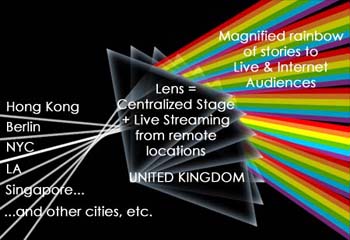
Our Vision: to unleash the creative potential of a multicultural collective via technology.
Timewave aims to bring audiences together to experience a performance that is simultaneously theatrical, cinematic, and Internet-driven, and where audiences can contribute via social media and telepresence.
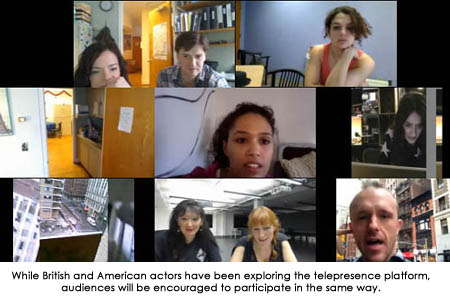
By using telepresence and broadcasting technologies that have been migrated to the cloud, TimeWave creates a new code for an international live arts event. Theatre from multiple locations can be streamed into a single performance, enabling local audiences to travel around the world and never leave their seats.
Current technology integrates HD video, audio and interactive tools, which results in a powerfully immersive experience. By combining technology and production design, local and remote artists and audiences feel as if they are existing in the same time and space.
Eliminating travel leads to a reduction in CO2 emissions causing climate change and will empower us to reach a low carbon future. TimeWave enables cultural exchange without doing damage to our planet.
"Creating a global network of more than 4,000 high quality videoconferencing studios in cities around the world would help build a new infrastructure for the 21st century and would cost less than one and a half airplanes," says Dennis Pamlin, a WWF Policy Advisor.
Theme: Transformation
Dozens of award-winning artists and multimedia creators, such as Berkeley's Smith/Wymore Disappearing Acts and Montreal's Teoma Naccarato, from around the world will gather in London, May 2013. Writers and multimedia creators have reflected on change. It could be a personal cathartic moment — a window into the cosmos — or an imagined couple's journey into space.
We've also encouraged traditional theatre artists to spread their wings and explore the use of new technology in their work. Many have embraced the opportunity, and written startling pieces that take advantage of mediated reality and environments.
The Programme
Each performance in the festival will consist of a two-hour event, knitting together 8 to 10 short pieces from playwrights and multimedia creators to form a kaleidoscopic tapestry. Over the five-day run, the programme will resemble a prism shifting every few minutes to reveal a unique voice, style or viewpoint.
As TimeWave progresses, multiple works from different artists will unfold like the ebb and flow of water currents — intersecting, overlapping, interweaving — that form, in total, a wave.
Audiences can participate TimeWave not only as commentators but as creators.
In one format for TimeWave, audiences can interpret a piece in real time. They can hone in on the subtext of a scene and write their own dialogue, expressing it via SMS text inputs. The scene can be as simple as a couple having a cuppa - but are they truly enjoying each other? Conflict may be bubbling beneath the surface, so what's really going on? Actors may also pose a high stakes scene in which a person is about to jump from a rooftop. Audiences can riff on the jumper's internal monologue.
In another audience-participation format, we will set up a virtual room.
A question will be posed, such as "if you had one power, what would it be?" Remote audience members can pop in and out of the room and answer the question in one or two lines. Instead of a roving interviewer traveling to different parts of the world, people from various regions of the world can leap into the virtual space and have their say.


